Are you Health Professional?
Register now, join the community for free access.
GET ALL THE BENEFITS THAT MEDTUBE PLATFORM OFFERS:
- Unlimited access to the largest e-library of professional videos, images, publications, courses
- Connect with peers 450,000+ Healthcare Professionals from 180 countries
- Upload and share your own cases, ask questions and discuss
- Create your professional profile and build personal recognition worldwide
- Stay up-to-date with innovative techniques, treatments, guidelines, discoveries in your fields of interest; be notified
- You are informed about innovative treatments, techniques and innovations in medicine

The Pocket Doesn't Prevent Bleeding. It Suspends it. And with the Frozen Effect, it Ends it.

Case description
The pocket doesn't prevent bleeding.It suspends it. And with the Frozen Effect, it ends it.
A physics-first reframing of hemostasis in pocket-creation method ESD and a channel-native maneuver that requires no additional devices. It's all about The Physics. Pure fluid mechanics.
In a closed or semi-closed cavity, fluid pressure follows Pascal's principle: pressure applied to an enclosed fluid is transmitted equally in all directions. The submucosal pocket in PCM, particularly when the mucosal entry incision is minimal,
The observation
When you work inside a pocket, you are inside a pressure chamber. Continuous saline irrigation through the water-jet or knife channel fills a semi-closed submucosal space. That fluid column exerts hydrostatic pressure against every wall - including the walls of exposed submucosal vessels. If that pressure meets or exceeds intraluminal vessel pressure, the vessel doesn't bleed. Not because it's been coagulated. Not because it's been avoided. Because it's been mechanically suppressed by the fluid surrounding it.
The bleeding doesn't appear when the vessel is injured. It appears when the irrigation stops. That moment irrigation cessation is the true hemostatic stress test of PCM-ESD.
The pressure-unmasking event.
Every time you pause irrigation to reposition, to assess, to change instruments you drop the pocket pressure. The vessel, which was always open and always under intravascular pressure, is now unopposed. It bleeds.
This isn't new bleeding. It isn't delayed bleeding. It's pressure-unmasking. The vessel was there the whole time. The irrigation was the only thing holding it. This reframes when you should be most vigilant: not during active dissection, but at the moment irrigation stops.
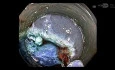
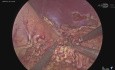
Once you understand pressure-unmasking, the hemostatic response becomes obvious. Don't reach for the hemostatic forceps. Don't swap instruments. Don't lose position. Restore irrigation. The field clears. The vessel is now visible, suppressed, and isolated by the fluid column. Then simultaneously apply swift coagulation current through the same channel. The vessel whitens. It becomes static. Frozen.
That's the Frozen Effect: simultaneous irrigation and coagulation current, delivered through the channel already in use, whitening the vessel in a single motion without any instrument exchange.
The word "frozen" refers to the visual endpoint. The vessel whites and goes still frozen in appearance under the combined effect of hydrostatic suppression and coagulation current.
Channel selection isn't convenience. It's calibrated to the hemostatic demand of the target. Larger vessels carry higher intraluminal pressure they require more robust external suppression before coagulation can work cleanly.
The complete sequence
1 · Continuous irrigation during dissection → hydrostatic tamponade → vessels silent
2 · Irrigation cessation → pressure-unmasking → vessel declares itself
3 · Irrigation restoration → re-suppression → field clears, vessel isolated
4 · Simultaneous irrigation + swift coag → vessel whitens → Frozen Effect → dissection resumes No device exchange. No assistant. No positional loss.
What this changes
Irrigation is not a visibility tool. Inside the pocket it is an active hemostatic agent and its cessation is a deliberate diagnostic event. Hemostatic forceps remain available. But in PCM-ESD, the channel you're already holding is often the only instrument you need. Two channels. One motion. The vessel freezes white.
This user also sharing
ERCP for Hilar Malignancy
boudabbous sami
views: 496
P-EMR For A 35 mm Right Colon NG-LST
boudabbous sami
views: 1375
Recommended
Gastrointestinal Stomal Tumor
Dedy Chandra
views: 27