World Health Summit - publications, events, lectures
- Street address
-
Charitéplatz 1
10117 Berlin
Germany
- Founded at
- 2009-01-01
- Website
- World Health Summit
- Views
- 57793
- Description
- The World Health Summit is one of the world’s leading strategic forums for global health and brings together leaders from politics, science and medicine, the private sector, and civil society to set the agenda for a healthier future. The World Health Summit was founded in 2009 on the occasion of the 300th anniversary of Berlin’s Charité Hospital and is traditionally held under the patronage of the German Chancellor, the President of the Republic of France, the President of the European Commission, and the Director-General of the World Health Organization (WHO). The academic foundation of the World Health Summit is the M8 Alliance of Academic Health Centers, Universities, and National Academies of Medicine and Sciences, a unique network of leading academic health centers, universities, and research institutions from all over the world. In addition to the World Health Summit in October in Berlin, the M8 Alliance organizes annual Regional Meetings and Expert Meetings around the world. The vision behind the World Health Summit is to improve health worldwide through collaboration and open dialogue, steering tomorrow’s agenda towards the improvement of research, education, healthcare and policy outcomes. The World Health Summit promotes a science-driven and broad approach to global health development with the Sustainable Development Goals (SDGs) at its core. The key issues are therefore interdisciplinary, science-based, cross-sectoral, and concerted. They are vital to set the global health agenda for the years to come. Health is more than medicine and health is a human right - the truth of that statement has grown increasingly obvious and relevant. For both individuals and societies, nothing is more important than health. Only a holistic approach to health that includes biology, lifestyle, and environment is likely to deliver positive results. If we want to succeed sustainably, science, politics, civil society, and the private sector have to work together to improve health and living conditions for everyone, everywhere. That is the aim of the World Health Summit. Science has to take responsibility in order to guarantee testable explanations and predictions. As academics, we believe in the power that developing knowledge holds, along with the transmission and translation of science from bench to bedside that will lead to better health for all. We at the World Health Summit will continue to promote health as a human right, along with good governance, because political decisions without exception affect human health.
Latest content


PD 27 - Unlocking Digital and AI Technologies for Health
As we have seen with financial payments and credit, the digital transformation of the health sector can be key to including the poorest and the most vulnerable into inclusive, affordable national health...
WS 13 - Are Countries Ready for the Next Pandemic?
The COVID-19 crisis has revealed suboptimal levels of country response, resulting in huge impact on individuals, communities, societies and economies. The Economist Impact has completed a research project,...
PD 11 - Strengthening Universal Health Coverage
We are only a decade away from meeting the targets outlined in SDG 3 - in particular, Universal Health Coverage. At a global level, UHC index has improved from 45.8 in 1990 to 60.3 in 2019, but the achievement...

KEY 06 - WHO Council on the Economics of Health for All
Global Health needs new economic thinking – a proactive Health for All economic agenda, to shape our economies so they truly have wellbeing and inclusion at the center of how we create value, measure...
PD 28 - Vaccine Policy for Health Equity
The accelerated development and deployment of novel vaccines against COVID-19 made it possible to offer vaccination against this pandemic for virtually everybody in high income countries one year after...
KEY 05 - The Role of the European Union in Global Health
The initiatives to create a European Health Union entail an important political opportunity to strengthen the global health role of the EU. The EU’s internal legal and political capacity for health immediately...
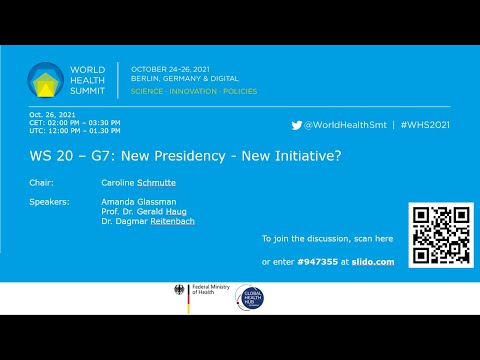
WS 20 - G7: New Presidency - New Initiative?
In the declarations of the “G-formats”, member states have shown a tendency to come up with new initiatives tackling (among others) issues related to global health outside of the UN system, such as the...
D 13 - Investing in Women and Resilient Health Systems
Sexual, reproductive, maternal, newborn and adolescent health (SRMNAH) is an essential component of the Sustainable Development Goals. Improving SRMNAH requires increased commitment to, and investment...
WS 19 - Pettenkofer Talks: How to Build a Career in Global Health
With Pettenkofer Talks, we would like to point out and make attractive possible career paths and professions to interdisciplinary young professionals in the field of Global Public Health through an interactive,...
D 12 - Health Inequalities & Youth: The COVID-19 Pandemic and...
The COVID-19 pandemic has highlighted and exacerbated pre-existing health inequalities across the world. The pandemic has pushed health systems to their core causing an unequal distribution of deaths...

PD 26 - Protecting Essential Health Services for Women and Adolescents
As world leaders strive to bring the spread of COVID-19 under control, a secondary health crisis rages in many lower income countries. The COVID-19 pandemic disrupts access to many essential health services,...
PD 24 - Challenges for Children Today: Climate, COVID and Commercial...
Are we doing enough to ensure health and well-being for the world's children, the future of our global population? Clearly not, says an international Commission of child health experts, who, in February...
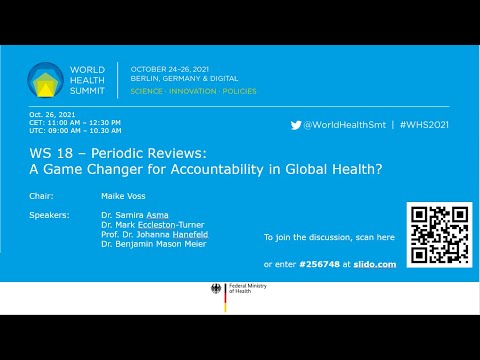
WS 18 - Periodic Reviews: A Game Changer for Accountability in Global...
The International Health Regulations (IHR) were introduced in 1969 and reformed in 2005 by the World Health Organizations (WHO) with the aim to prevent, detect and respond to the international spread...
PD 25 - The Socio-Economics of Pandemics Policy
The immediate policy responses to the outbreak of a pandemic are non-pharmaceutical interventions: social distancing and the lock-down of many economic and social activities. In rich economies, the interventions...
WS 17 - Epidemic Preparedness beyond COVID-19
Pandemics did not take much public attention in Europe and other industrialized nations during the last decades and before the COVID-19 outbreak. Also preparedness and response systems have not been adequately...
Top content


PD 27 - Unlocking Digital and AI Technologies for Health
As we have seen with financial payments and credit, the digital transformation of the health sector can be key to including the poorest and the most vulnerable into inclusive, affordable national health...
WS 13 - Are Countries Ready for the Next Pandemic?
The COVID-19 crisis has revealed suboptimal levels of country response, resulting in huge impact on individuals, communities, societies and economies. The Economist Impact has completed a research project,...
D 09 - The Pathfinder Initiative: Pathways to a Healthy, Zero Carbon...
Urgent and decisive action is needed to keep within the 1.5 - 2° C target of the Paris Agreement. This session will discuss the work of the Pathfinder Initiative (including The Lancet Pathfinder Commission)...
D 12 - Health Inequalities & Youth: The COVID-19 Pandemic and...
The COVID-19 pandemic has highlighted and exacerbated pre-existing health inequalities across the world. The pandemic has pushed health systems to their core causing an unequal distribution of deaths...
PD 28 - Vaccine Policy for Health Equity
The accelerated development and deployment of novel vaccines against COVID-19 made it possible to offer vaccination against this pandemic for virtually everybody in high income countries one year after...
PD 11 - Strengthening Universal Health Coverage
We are only a decade away from meeting the targets outlined in SDG 3 - in particular, Universal Health Coverage. At a global level, UHC index has improved from 45.8 in 1990 to 60.3 in 2019, but the achievement...
KEY 06 - WHO Council on the Economics of Health for All
Global Health needs new economic thinking – a proactive Health for All economic agenda, to shape our economies so they truly have wellbeing and inclusion at the center of how we create value, measure...
PD 19 - The Role of Policymakers in Digital Health Innovation
According to WHO estimates, half of the world’s population lacks access to essential health services. Over 100 million people each year fall into extreme poverty because they have to pay out of pocket...
PD 23 - Future Directions for Global Health Security
Global Health Security has come back into focus in the context of the COVID-19 pandemic. There are discussions under way to explore new and broader concepts of health security: clearly the approach must...
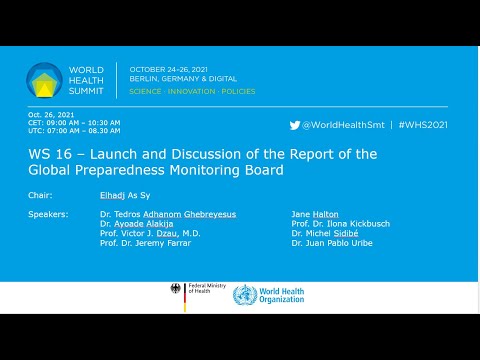
WS 16 - Launch and Discussion of the Report of the Global Preparedness...
In this session the GPMB co-chairs will launch the 2021 Report of the Global Preparedness Monitoring Board, presenting its key findings and calls for action. In its 2019 report, "A World at Risk", the...
D 13 - Investing in Women and Resilient Health Systems
Sexual, reproductive, maternal, newborn and adolescent health (SRMNAH) is an essential component of the Sustainable Development Goals. Improving SRMNAH requires increased commitment to, and investment...
WS 20 - G7: New Presidency - New Initiative?
In the declarations of the “G-formats”, member states have shown a tendency to come up with new initiatives tackling (among others) issues related to global health outside of the UN system, such as the...
PD 24 - Challenges for Children Today: Climate, COVID and Commercial...
Are we doing enough to ensure health and well-being for the world's children, the future of our global population? Clearly not, says an international Commission of child health experts, who, in February...
KEY 05 - The Role of the European Union in Global Health
The initiatives to create a European Health Union entail an important political opportunity to strengthen the global health role of the EU. The EU’s internal legal and political capacity for health immediately...
D 08 - Capacity Building for Excellence in Health Care for Women
Although much attention is given by development agencies to women reproductive health services in the global south, a comprehensive vision for capacity building in women health services is still lacking....

World Health Summit 2026
Health around the world is being challenged by compounding crises that are testing systems, widening inequities, and exposing vulnerabilities that cannot be addressed...
World Health Summit 2021
3 DAYS - 50 SESSIONS - 100 NATIONS - 300 SPEAKERS - 6,000 PARTICIPANTS - BERLIN & DIGITAL A leading international forum for global health. With science,...

World Health Summit Regional Meeting 2022 – Italy, Rome...
We announce that the World Health Summit Regional Meeting 2022, Italy, Rome will take place in Sapienza University of Rome on June 15-17, 2022. Each year, the Regional...
World Health Summit 2022
3 DAYS - 100 NATIONS - 400 SPEAKERS - 6,000 PARTICIPANTS - BERLIN & DIGITAL A leading international forum for global health With science, politics, the...
World Health Summit 2023
WORLD HEALTH SUMMIT – FINDING SOLUTIONS FOR GLOBAL HEALTH The World Health Summit is the unique international strategic forum for global health. Held annually...
World Health Summit Regional Meeting 2023 USA, Washington...
The M8 Alliance of Academic Health Centres, Universities, and National Academies will run the World Health Summit Regional Meeting 2023 on April 13th, 2023 in Washington,...
World Health Summit 2024
The World Health Summit is the unique international platform for global health. It brings together stakeholders from politics, science, the private sector, and...

World Health Summit 2025
The World Health Summit is the unique international strategic forum for global health. Held annually in Berlin, it brings together stakeholders from politics,...


Kampala Declaration on COVID-19 Vaccine Equity - June 2021
Kampala Declaration on COVID-19 Vaccine Equity - June 2021

Alliance Statement - World Health Summit - 2019 Berlin
Alliance Statement - World Health Summit - 2019 Berlin
Are you Health Professional?
Register now, join the community for free access.
GET ALL THE BENEFITS THAT MEDTUBE PLATFORM OFFERS:
- Unlimited access to the largest e-library of professional videos, images, publications, courses
- Connect with peers 450,000+ Healthcare Professionals from 180 countries
- Upload and share your own cases, ask questions and discuss
- Create your professional profile and build personal recognition worldwide
- Stay up-to-date with innovative techniques, treatments, guidelines, discoveries in your fields of interest; be notified
- You are informed about innovative treatments, techniques and innovations in medicine