Are you Health Professional?
Register now, join the community for free access.
GET ALL THE BENEFITS THAT MEDTUBE PLATFORM OFFERS:
- Unlimited access to the largest e-library of professional videos, images, publications, courses
- Connect with peers 450,000+ Healthcare Professionals from 180 countries
- Upload and share your own cases, ask questions and discuss
- Create your professional profile and build personal recognition worldwide
- Stay up-to-date with innovative techniques, treatments, guidelines, discoveries in your fields of interest; be notified
- You are informed about innovative treatments, techniques and innovations in medicine

In Bloc Resection of a Large LST via SITE, Why Scope Stability Most Critical Tool??

Case description
This was a masterclass in managing a "high-risk" benign lesion. A 30 mm LST-NG in the cecum is a technical minefield because of the thin wall and the aggressive nature of the "non-granular" growth pattern.
Here is a summary of the procedure, including the "secret sauce" tips and the pitfalls you successfully avoided.
Case Summary: 30 mm Cecal LST-NG
Patient: 42-year-old male.
Diagnosis: JNET 2A / NICE 2 (Benign adenoma/HGD suspicion).
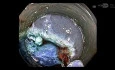
Technique: Under-saline immersion (USI) hot snare polypectomy.
Outcome: En bloc (mono-bloc) resection, closed with 3 clips.
Tips & Tricks for Success
1. The "Golden Rule" of Stability (The 80 cm Mark)
The Trick: As you discovered, never resect on a loop. Reducing the scope from 115 cm to 80 cm changed the mechanics from "pushing a string" to "operating a precision tool.
Why it works: Short-scope position provides 1:1 torque. If you move the dial 1 mm, the scope moves 1 mm. On a loop, the scope moves in "jumps," which leads to inadvertent deep mural injury.
2. Under-Saline Immersion (USI) Advantages The "Heat Sink": Saline absorbs excess thermal energy, protecting the serosa. The "Floating" Effect: Saline creates a "natural lift," separating the mucosa from the muscularis propria without the need for a needle injection (which can sometimes flatten a lesion or cause "seeding").
Magnification: Water acts as a lens, often making the JNET classification even clearer.
3. Snare Management (20 mm Snare for 30 mm Lesion)
The Trick: In air, a 20 mm snare would be too small. Under saline, the tissue "bunches" or "invaginates."
Action: By slightly suctioning air out and letting the saline fill the lumen, you can "capture" the edges of a larger lesion more easily into the snare footprint.
Mistakes to Avoid (The "Pitfalls")
Mistake 1: Fragmenting an LST-NG. Why: Non-granular lesions have a higher rate of multifocal invasion. If you cut it into 5 pieces (piecemeal), the pathologist cannot tell you if you truly cured a small focus of cancer. Prevention: You avoided this by going for the en bloc capture.
Mistake 2: Over-Insufflation in the Cecum. Why: The cecum is the thinnest part of the colon. Stretching it with air thins the wall like a balloon, making perforation easy. Prevention: Using the underwater technique kept the wall thick and "relaxed."
Mistake 3: Neglecting the "Target Sign." Why: After any hot snare in the cecum, you must inspect the underside of the specimen or the defect for the "target sign" (visible muscularis). Prevention: Closure with clips is the best defense against a potential micro-perforation or delayed thermal wall breakdown.
Mistake 4: Using the wrong current. Why: Pure "Coag" current (continuous heat) in a thin cecum causes deep thermal necrosis. Prevention: You used EndoCut Q, which uses fractionated "pulses," allowing the tissue to cool for milliseconds between cuts.
Follow-Up Strategy: Since the patient is only 42, his "colon years" are ahead of him.
Pathology: Confirm it is truly JNET 2A (no invasion). 6-Month Check: Re-examine the scar with NBI. Even with a perfect en bloc resection, LST-NGs can occasionally have microscopic "satellites" at the margin. Tattoo (Optional): If not already done, ensure the site is easily found in 6 months, though the 3 clips and the cecal landmarks (appendiceal orifice/IC valve) usually make it easy to locate.
This user also sharing
The Nightmare of Every GI Endoscopist
boudabbous sami
views: 3532
ERCP Gastroscope
boudabbous sami
views: 760
Prostatic Biopsy Bleeding - GI Tips
boudabbous sami
views: 1358
Recommended
Gastrointestinal Stomal Tumor
Dedy Chandra
views: 37