Are you Health Professional?
Register now, join the community for free access.
GET ALL THE BENEFITS THAT MEDTUBE PLATFORM OFFERS:
- Unlimited access to the largest e-library of professional videos, images, publications, courses
- Connect with peers 450,000+ Healthcare Professionals from 180 countries
- Upload and share your own cases, ask questions and discuss
- Create your professional profile and build personal recognition worldwide
- Stay up-to-date with innovative techniques, treatments, guidelines, discoveries in your fields of interest; be notified
- You are informed about innovative treatments, techniques and innovations in medicine

Beyond the Duodenoscope: Optimizing Outcomes with Direct Peroral Cholangioscopy in Complex Biliary Cases

Case description
When the duodenoscope meets its match: solving the "mega-duct" challenge.
ERCP in a 28 mm "mega-duct" with a massive stone burden (30+ stones) is a known challenge, but what happens when you discover a 10 Fr plastic stent has migrated into the right hepatic duct, and standard retrieval tools reach their limit?
Today, I managed an 83-year-old patient who presented with this exact clinical puzzle. After initial stone clearance and Endoscopic Papillary Large Balloon Dilation (EPLBD) up to 16.5 mm, we faced a retrieval roadblock. Our standard baskets, forceps, and snares failed to capture the migrated stent under the traditional side-viewing approach.
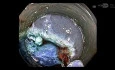
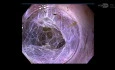
The Strategy: Rather than struggling with suboptimal angles, we pivoted. We transitioned to a front-viewing gastroscope for direct peroral cholangioscopy.
By leveraging the axial view and 4-way tip deflection, we:
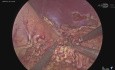
- gained direct visual access to the migrated stent.
- successfully snared and extracted the stent under direct visualization.
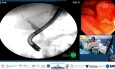
- performed a final, meticulous sweep of the 28 mm duct with saline irrigation and a balloon, confirming 100% clearance on the final occlusion cholangiogram.
The Final Touch: We left a 10 Fr 7 cm double pigtail stent as a "safety valve" to ensure drainage and maintain papillary patency during the recovery phase.
Key Takeaway: When standard maneuvers fail in a dilated biliary system, don't be afraid to think - and move - outside the duodenoscope. Direct visualization with a front-viewing scope is an underutilized, high-impact tool in the advanced endoscopist’s armamentarium.
Patient is resting comfortably 4 hours post-procedure, hemodynamically stable.
This user also sharing
The Nightmare of Every GI Endoscopist
boudabbous sami
views: 3532
ERCP Gastroscope
boudabbous sami
views: 759
Prostatic Biopsy Bleeding - GI Tips
boudabbous sami
views: 1358
Recommended
Gastrointestinal Stomal Tumor
Dedy Chandra
views: 37