Are you Health Professional?
Register now, join the community for free access.
GET ALL THE BENEFITS THAT MEDTUBE PLATFORM OFFERS:
- Unlimited access to the largest e-library of professional videos, images, publications, courses
- Connect with peers 450,000+ Healthcare Professionals from 180 countries
- Upload and share your own cases, ask questions and discuss
- Create your professional profile and build personal recognition worldwide
- Stay up-to-date with innovative techniques, treatments, guidelines, discoveries in your fields of interest; be notified
- You are informed about innovative treatments, techniques and innovations in medicine

Laparoscopic Total Mesorectal Resection of Bulky Tumors in Male

Case description
“Technical Approach to Laparoscopic Low Anterior Resection for Bulky Rectal Tumors”.
1. Preoperative Planning
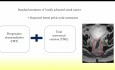
Bulky rectal tumors, typically ≥5 cm, require precise planning with high-resolution pelvic MRI to assess mesorectal involvement, CRM status, and feasibility of a laparoscopic approach. Bowel preparation, ureteric identification strategies, and selective preoperative stenting are factored into planning.
2. Patient Positioning & Port Strategy
The patient is placed in modified lithotomy with steep Trendelenburg and right-side tilt. A standard five-port technique is used: a supraumbilical camera port, two working ports in the right and left lower quadrants, and two assistant ports. Proper ergonomics are critical due to restricted pelvic working space.
3. Vascular Control“We begin with medial-to-lateral dissection.
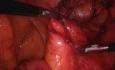
The inferior mesenteric artery is identified at its origin, skeletonized, and ligated using energy devices or clips, ensuring preservation of sympathetic nerves. The IMA division provides proximal mobilization essential for bulky tumors.
4. Sigmoid & Descending Colon Mobilization
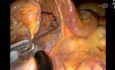
The mesosigmoid is mobilized along the avascular Toldt’s plane. Clear identification of the left ureter and gonadal vessels is mandatory, especially when dealing with large fixed tumors where traction is limited.
5. Total Mesorectal Excision (TME)
A sharp, precise mesorectal dissection is carried out circumferentially. For bulky tumors, the dissection requires careful handling of the mesorectal envelope to avoid CRM compromise. In the narrow pelvis, articulating instruments and controlled counter-traction are essential to maintain the correct TME plane.
6. Approaching the Distal Rectum
As the tumor bulk reduces mobility, dissection progresses sequentially from posterior to lateral to anterior planes. The peritoneal reflection is divided widely. Energy sources are used judiciously near the tumor to prevent thermal injury. A distal margin is secured under direct laparoscopic visualization.
7. Specimen Extraction & Proximal Transection
Once the TME is completed, the proximal colon is transected using a laparoscopic linear stapler. The specimen is extracted through a protected mini-Pfannenstiel incision. Tumor handling is minimized to maintain oncological integrity.
8. Anastomosis Formation
A double-stapled colorectal anastomosis is constructed. The bulky-tumor setting may require reinforcement sutures or a transanal approach to ensure precise staple line placement. An air leak test is routinely performed. A diverting loop ileostomy is considered for low anastomoses.”
9. Final Inspection & Closure
The pelvis is irrigated thoroughly. Hemostasis is confirmed, drains are placed selectively, and ports are closed. Postoperative protocols follow an enhanced recovery pathway.
Laparoscopic LAR for bulky rectal tumors is technically demanding but feasible with proper planning, meticulous TME technique, and experienced surgical execution. This approach preserves oncologic outcomes while offering the benefits of minimally invasive surgery.