Are you Health Professional?
Register now, join the community for free access.
GET ALL THE BENEFITS THAT MEDTUBE PLATFORM OFFERS:
- Unlimited access to the largest e-library of professional videos, images, publications, courses
- Connect with peers 450,000+ Healthcare Professionals from 180 countries
- Upload and share your own cases, ask questions and discuss
- Create your professional profile and build personal recognition worldwide
- Stay up-to-date with innovative techniques, treatments, guidelines, discoveries in your fields of interest; be notified
- You are informed about innovative treatments, techniques and innovations in medicine

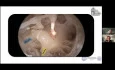
Endoscopic Sinus Surgery Anterior Ethmoidectomy Dissection

Case description
A short demonstration of an anterior ethmoidectomy dissection. The bulla ethmoidalis is a constant, variably sized landmark and is the entry point into the anterior ethmoid complex. It is safely entered infero-medially using any kind of instrument. Bone and sinus mucosa are removed, and dissection proceeds on a broad front; the next ethmoid air cell is then identified and entered. The lateral limit of the dissection is the lamina papyracea, the medial limit the middle turbinate, the superior limit the skull base, and the posterior limit the basal lamella, which is part of the attachment of the middle turbinate to the lateral nasal wall and separates the anterior and posterior ethmoid air cells. The key structures at risk during this step of the surgery are the orbit and the skull base. Staying medially to a sagittal plane, defined by the medial wall of the maxillary sinus, ensures that the surgeon does not enter the orbit, assuming that the medial wall of the maxillary sinus has not been lateralized (as in silent sinus syndrome). Or the medial wall of the orbit is not medialized (as in previous orbital wall decompression). The risk of accidental entry into the orbit is increased if an infraorbital cell is present, which is in 12% of patients. In 8% of patients, the cribriform plate and the lateral lamella are low-lying and asymmetrical. This increases the risk of skull base and intracranial complications. The risk of orbital injury further increases when the supraorbital region is pneumatized. Supraorbital pneumatization is also usually associated with low-lying "hanging" anterior ethmoid arteries, which could be damaged during the anterior ethmoid dissection and should be identified preoperatively. All the above emphasizes the importance of careful analysis of CT scans prior to surgery. It is important to avoid instrumentation of the frontal recess during this phase of surgery. In most cases, complete clearance of the anterior ethmoids followed by adequate medical treatment is sufficient for the treatment of frontal sinus disease. One should always remember that instrumentation in the frontal sinus greatly increases the risk of iatrogenic stenosis and difficult to treat frontal sinus disease.
This user also sharing
Endoscopic Anatomy of the Ear
Ricardo Bartel
views: 5996
Recommended
Glomus Tympanicum
Dritan Vasili
views: 588
Supraglottic Hemangioma
Theodoros Kravvaritis
views: 488
An Epiglottic Inclusion Cyst
Rahmat Omar
views: 706