Are you Health Professional?
Register now, join the community for free access.
GET ALL THE BENEFITS THAT MEDTUBE PLATFORM OFFERS:
- Unlimited access to the largest e-library of professional videos, images, publications, courses
- Connect with peers 450,000+ Healthcare Professionals from 180 countries
- Upload and share your own cases, ask questions and discuss
- Create your professional profile and build personal recognition worldwide
- Stay up-to-date with innovative techniques, treatments, guidelines, discoveries in your fields of interest; be notified
- You are informed about innovative treatments, techniques and innovations in medicine

Intestinal Metaplasia of the Pre-Piloric Antrum. Chronic gastritis with intestinal metaplasia (2 of 3)
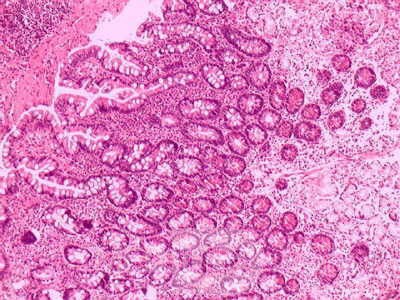

Case description
Other promoters of IM
These include lack of vitamin C and cigarette smoking.
The concept of atrophy, subsequent hypochlorhydria with
bacterial overgrowth, and nitrate generation that damage
DNA must also be considered. A European study showed
that patients with IM had a significantly higher proportion
of gastric juice samples containing bacteria and nitrite and
had a gastric pH >6. The role of hypochlorhydria is
interesting; studies in rats with IM induced by irradiation
showed reversal following lowering of gastric pH. Bile is
also a major factor in promotion of IM. An early study
from Leeds showed that after stratification for previous
surgery, age, and H pylori status, the histological feature
most strongly associated with bile reflux was IM, including
all subtypes. Bile in combination with H pylori in rats
promotes cyclooxygenase 2 (COX-2) expression in body
mucosa and when bile was added, COX-2 expression in
histologically normal appearing body mucosa was
associated with cell proliferation, atrophy, and IM in the
antrum. Sung et al also showed that both premalignant and
malignant gastric lesions in human subjects demonstrate
high COX-2 expression. Successful eradication of H pylori
caused downregulation of COX-2 expression but failed to
reverse IM at one year.
These include lack of vitamin C and cigarette smoking.
The concept of atrophy, subsequent hypochlorhydria with
bacterial overgrowth, and nitrate generation that damage
DNA must also be considered. A European study showed
that patients with IM had a significantly higher proportion
of gastric juice samples containing bacteria and nitrite and
had a gastric pH >6. The role of hypochlorhydria is
interesting; studies in rats with IM induced by irradiation
showed reversal following lowering of gastric pH. Bile is
also a major factor in promotion of IM. An early study
from Leeds showed that after stratification for previous
surgery, age, and H pylori status, the histological feature
most strongly associated with bile reflux was IM, including
all subtypes. Bile in combination with H pylori in rats
promotes cyclooxygenase 2 (COX-2) expression in body
mucosa and when bile was added, COX-2 expression in
histologically normal appearing body mucosa was
associated with cell proliferation, atrophy, and IM in the
antrum. Sung et al also showed that both premalignant and
malignant gastric lesions in human subjects demonstrate
high COX-2 expression. Successful eradication of H pylori
caused downregulation of COX-2 expression but failed to
reverse IM at one year.
Other photos of this user

Esophageal Stent - X-ray
Gastroenterology Atlas
views: 7855


Recommended
Gastrointestinal Stomal Tumor
Dedy Chandra
views: 93