Are you Health Professional?
Register now, join the community for free access.
GET ALL THE BENEFITS THAT MEDTUBE PLATFORM OFFERS:
- Unlimited access to the largest e-library of professional videos, images, publications, courses
- Connect with peers 450,000+ Healthcare Professionals from 180 countries
- Upload and share your own cases, ask questions and discuss
- Create your professional profile and build personal recognition worldwide
- Stay up-to-date with innovative techniques, treatments, guidelines, discoveries in your fields of interest; be notified
- You are informed about innovative treatments, techniques and innovations in medicine

ERCP in Locally Advanced Pancreatic Cancer, what Happens when your ERCP Landmarks Disappear?

Case description
A 55-year-old man. Acute cholangitis. Locally advanced pancreatic head neoplasia. Hepatic lesions. On paper, a biliary drainage procedure. In reality, one of the most technically demanding scenarios an interventional endoscopist can face.
Here is what happened in the room — and what I want every endoscopist to know before they face this themselves.
The anatomical challenge tumoral involvement of the pancreatic head had retracted the second duodenum. The papilla was no longer where it should be. Scope position, angle of approach, and the geometry of cannulation — everything was shifted. Access to the CBD was genuinely difficult.
This is the scenario that separates ERCP as a routine skill from ERCP as a craft.
Pitfalls — and how to navigate them
1 · Duodenal retraction displacing the papilla
The papilla migrates anteriorly and inferiorly. Standard en face position is lost. Conventional cannulation technique will fail or put you at high risk of perforation.
Tip: Use the long scope position if needed. Adjust elevator tension dynamically. A rotatable sphincterotome gives you the angulation control you cannot get from scope torque alone in a fixed, retracted D2.
2 · Difficult selective CBD cannulation
Periampullary distortion biases the catheter toward the pancreatic duct. Repeated PD cannulation is a setup for post-ERCP pancreatitis — already elevated risk in this context.
Tip: Early guidewire-assisted cannulation. If PD is repeatedly entered, place a prophylactic PD stent before proceeding further. Consider needle-knife precut early rather than late — excessive trauma from repeated attempts is worse than a well-timed precut.
3 · Sphincterotomy in a distorted papilla
A limited sphincterotomy in this anatomy carries higher bleeding risk — the vessels don't run where you expect them, and the direction of the cut may be off-axis.
Tip: Keep the sphincterotomy minimal — just enough for SEMS delivery. In palliation, you are not trying to achieve complete sphincter division. Controlled, short cut. Blended current, not pure cut. Have adrenaline-saline injection ready.
4 · SEMS choice: uncovered vs. covered
In locally advanced, unresectable disease with a hepatic lesion, the oncologic context determines stent strategy. Covered SEMS can migrate; uncovered SEMS embed and are permanent.
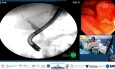
Tip: Uncovered SEMS is the correct palliative choice here — lower migration risk, better radial force against extrinsic compression, and the permanence is appropriate given the prognosis. Position the stent to bridge the stricture with adequate proximal and distal purchase. Confirm position fluoroscopically before deployment.
5 · Confirming adequate biliary drainage
Contrast drainage into the CBD does not automatically mean clinical decompression is achieved. The stent must traverse the dominant stricture fully and allow free flow.
Tip: After SEMS deployment, inject contrast proximal to the stent and confirm downstream flow. Check for bile draining from the scope at the end of the procedure. Clinical correlation at 24–48 hours (bilirubin trend, fever resolution) is the real endpoint.
6 · The hepatic lesion changes the equation
A hepatic metastasis defines M1 disease. This is not a bridge to surgery. Every decision — stent type, sedation risk, post-procedure management — must be calibrated to palliative intent and patient-centred goals.
Tip: In-room MDT thinking matters. Before you start the procedure, you should have clarity on whether the goal is palliation or bridging. It changes how aggressively you push, how many attempts you accept, and what you do if you fail.
The bottom lineWe achieved CBD access, performed a limited sphincterotomy, and placed an uncovered SEMS with confirmed biliary drainage. The procedure worked. But in this anatomy, nothing is automatic.
ERCP in locally advanced pancreatic cancer is not just a drainage procedure. It is a test of spatial reasoning, technical adaptation, and — critically — knowing when to stop and when to escalate to PTBD or EUS-guided rendezvous as a backup strategy. The anatomy changed. We adapted. The patient drained.
This user also sharing
The Nightmare of Every GI Endoscopist
boudabbous sami
views: 3535
ERCP Gastroscope
boudabbous sami
views: 763
Prostatic Biopsy Bleeding - GI Tips
boudabbous sami
views: 1358
Recommended
Gastrointestinal Stomal Tumor
Dedy Chandra
views: 37